Have you ever received a message that says, “DM me”, and wondered what it means? You are not alone. Many people see this short form every day on social media, in text messages, and even in online games.
The term DM is one of the most common internet abbreviations. It helps people move a public conversation into a private one.
If you use Instagram, X (formerly Twitter), Facebook, TikTok, Discord, or other apps, you will likely see this phrase often.
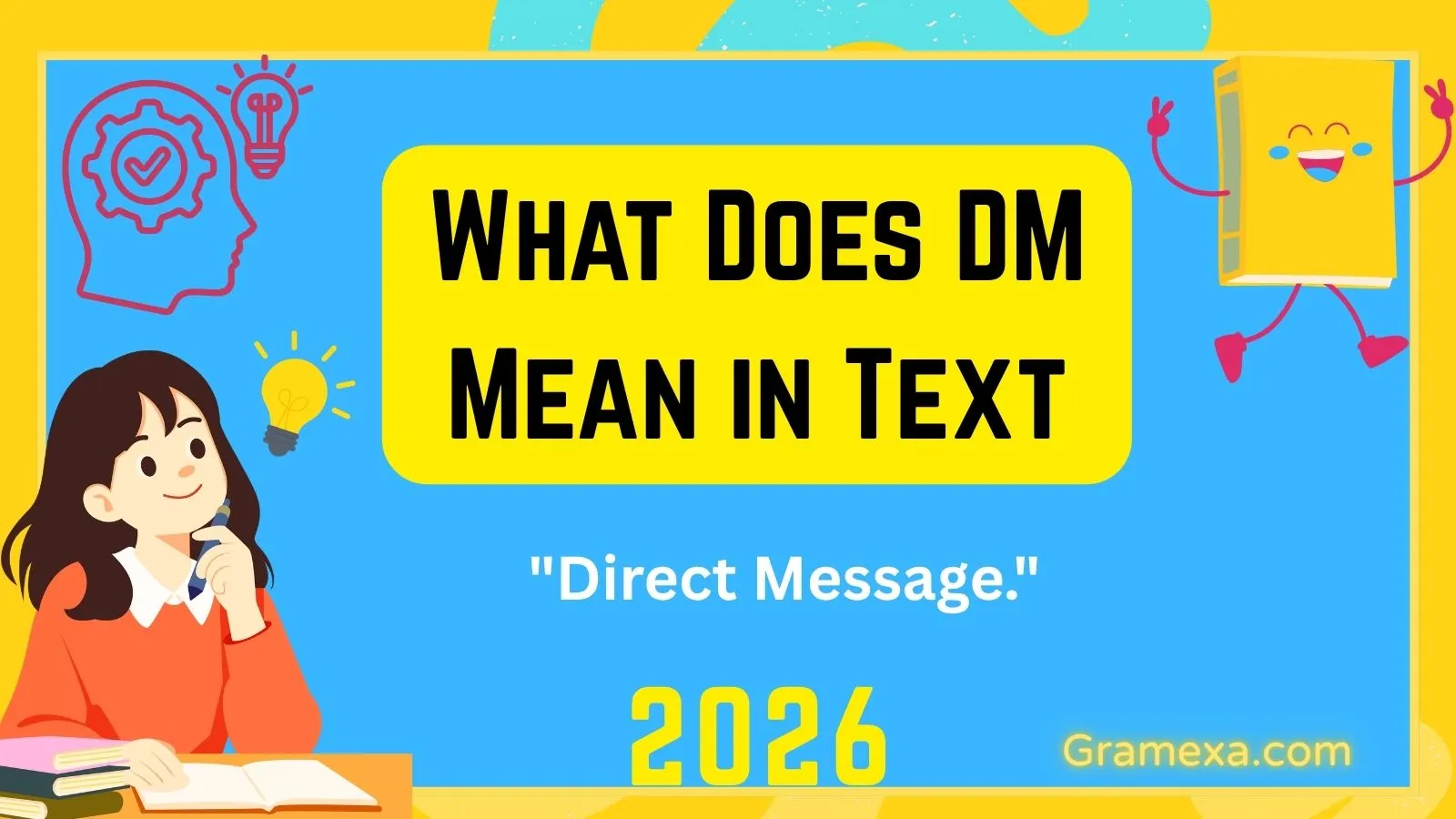
DM Stands For “Direct Message”
Knowing what DM means in text can help you communicate better and avoid confusion. It also makes online conversations easier and safer.
In this guide, you’ll learn the meaning of DM, where it came from, how people use it, how to reply when someone says “DM me,” and when it is appropriate to use it.
Let’s Dive In!
What Does DM Mean in Text?
A direct message is a private message sent from one person to another on a social media platform or online service. Unlike public comments or posts, only the sender and the receiver can see a DM.
People use DMs for many reasons, including:
- Private conversations
- Sharing personal information
- Sending photos or videos
- Talking about business
- Making plans
- Asking questions privately
Simple Example
Friend: “Can you send me the restaurant address?”
You: “Sure, I’ll DM it to you.”
In this example, the address is sent privately instead of posting it publicly.
Another Example
User A: “Where did you buy those shoes?”
User B: “I’ll DM you the link.”
Instead of sharing the link with everyone, they send it privately.
Why People Use DMs
People often prefer DMs because they:
- Protect privacy
- Keep conversations personal
- Avoid filling public comment sections
- Share sensitive information safely
Today, saying “DM me” simply means:
“Send me a private message.”
Background & History
The idea of private messaging existed long before social media.
In the early days of the internet, people chatted through:
- Online forums
- Chat rooms
- Instant messengers
- Email services
As social media became popular, platforms introduced private messaging features.
Twitter made the phrase Direct Message (DM) especially popular. Since Twitter used the name “Direct Message,” people quickly shortened it to DM.
Later, Instagram, Facebook, Discord, Reddit, TikTok, and many other apps adopted similar private messaging systems.
Today, the phrase is understood almost everywhere online.
Although some platforms now call it simply Messages, people still say:
- DM me
- Send me a DM
- Check your DMs
The abbreviation has stayed popular because it is short, easy, and recognized around the world.
Usage in Various Contexts
DM is used differently depending on where people are talking.
Text Messaging
Sometimes friends use DM when talking about social media.
Emma: “Did you send the pictures?”
Noah: “Yes, I sent them in your DM.”
People often move conversations from comments to DMs.
User A: “I love your artwork!”
Artist: “Thank you! DM me if you want a custom design.”
X (Twitter)
People use DMs to continue conversations privately.
User: “Can you help me with this issue?”
Company: “Please DM us your order number.”
Many businesses ask customers to send private messages.
Customer: “My package hasn’t arrived.”
Business: “Please DM your tracking number.”
Gaming
Players use DMs to discuss strategies.
Player 1: “Want to join our team?”
Player 2: “DM me the invite.”
Work
Some coworkers also use DMs.
Manager: “Can we discuss this privately?”
Employee: “Sure. I’ll send you a DM.”
Common Misconceptions & Clarifications
Many people misunderstand the meaning of DM.
Misconception 1: DM Only Means Instagram
False.
DM can refer to private messages on almost any platform.
Misconception 2: DM Means Text Message
- Not exactly.
- A text message uses your phone number.
- A DM is sent inside an app or website.
Misconception 3: DMs Are Always Private
They are private compared to public posts, but screenshots can still be shared.
Always think before sending personal information.
Misconception 4: DM Is Rude
Not at all.
It is a normal and polite way to ask someone to continue a conversation privately.
Similar Terms & Alternatives
Many apps use different names for private messages.
| Term | Meaning | Common Platform |
| DM | Direct Message | Instagram, X |
| PM | Private Message | Forums, Reddit |
| IM | Instant Message | Messaging apps |
| Message | General private message | |
| Inbox me | Send a private message | |
| Chat me | Start a private conversation | Many apps |
Although the names differ, they all describe private communication.
How to Respond to “DM Me”
Your response depends on the situation.
Casual Response
Friend: “DM me.”
You: “Sure!”
Friendly Response
Friend: “DM me when you’re free.”
You: “Will do!”
Funny Response
Friend: “DM me.”
You: “Incoming! 📩”
Professional Response
Customer: “Can I ask about pricing?”
Business: “Of course. Please send us a direct message.”
Privacy Conscious Response
Someone: “DM me your phone number.”
You: “I’d rather keep our conversation here for now.”
Always respond in a way that feels comfortable and safe.
Regional or Cultural Differences
DM is understood in many English speaking countries, including:
- United States
- Canada
- United Kingdom
- Australia
Many non English speakers also use the abbreviation because social media is global.
In some countries, people simply say:
- Message me
- Inbox me
- Send me a private message
The meaning stays almost the same.
Younger users tend to use DM more often than older users, but the term is becoming common across all age groups.
Comparison with Similar Terms
| Term | Full Form | Public or Private | Main Use |
| DM | Direct Message | Private | Social media |
| PM | Private Message | Private | Forums |
| SMS | Short Message Service | Private | Mobile texting |
| Chat | Conversation | Usually private | Messaging apps |
| Electronic Mail | Private | Business communication |
The biggest difference is that DM happens inside a platform, while SMS uses phone numbers and email uses email addresses.
Usage in Online Communities & Dating Apps
DM is extremely common online.
Dating Apps
People often move conversations into DMs after matching.
Example:
Alex: “Want to keep talking?”
Taylor: “Sure. DM me.”
Gaming Communities
Players exchange:
- Team invites
- Strategies
- Tournament details
through DMs.
Social Media Creators
Creators often write:
- DM for pricing
- DM for collaborations
- DM to order
- DM for more details
Customer Support
Many companies ask customers to continue conversations privately through DMs because personal information should not be shared publicly.
Hidden or Offensive Meanings
Most of the time, DM simply means Direct Message.
It is not offensive by itself.
However, context matters.
Sometimes strangers may send unwanted DMs.
This is why many social media apps let users:
- Block people
- Report messages
- Restrict who can send DMs
Always be careful when chatting with people you do not know.
Never share:
- Passwords
- Bank details
- Personal identification
- Sensitive information
A DM is private, but it should still be used wisely.
Suitability for Professional Communication
DM is acceptable in many business situations, especially on social media.
Examples include:
- Customer support
- Marketing
- Sales
- Networking
Professional example:
Customer: “Can you help with my order?”
Business: “Certainly. Please send us a direct message so we can assist you.”
However, for formal communication like job applications or legal matters, email is usually a better choice.
Professional alternatives include:
- Please send me a private message.
- Kindly contact me by email.
- Please reach out through our support portal.
- Feel free to message me directly.
Choose the communication method that best fits the situation.
FAQs:
Q1. What does DM mean in texting?
DM means Direct Message, which is a private message sent through an app or social media platform.
Q2. Is a DM the same as a text message?
No. A DM is sent inside an app, while a text message is sent using your phone number.
Q3. What does “DM me” mean?
It means “Send me a private message.”
Q4. Is DM only used on Instagram?
No. It is also used on X, Facebook, TikTok, Discord, Reddit, LinkedIn, and many other platforms.
Q5. Is it safe to send DMs?
Usually, yes. However, avoid sharing sensitive personal information with people you do not trust.
Q6. What is the difference between DM and PM?
Both mean private messaging. DM stands for Direct Message, while PM stands for Private Message.
Q7. Can businesses use DMs?
Yes. Many businesses use DMs for customer support, orders, and private discussions.
Conclusion:
Now you know What Does DM Mean in Text and why it is one of the most popular internet abbreviations.
DM stands for Direct Message, which allows people to communicate privately on social media and online platforms.
It is widely used by friends, businesses, gamers, influencers, and professionals to keep conversations personal and secure.
Understanding how and when to use DMs helps you communicate more confidently online. If someone says “DM me,” “Check your DMs,” or “I’ll send you a DM,” you’ll know they are asking for or referring to a private conversation.
Just remember to use good online safety habits, protect your personal information, and choose the right communication method for each situation.
Read More Posts
- What Does SMD Mean in Text Message? Real Meaning & Uses
- What Does IFK Mean in Text? Full Meaning Explained Simply
- What Does DR Mean in Text Messages and Social Media? (2026)

I am Grace Murphy a skilled grammar writer from United USA known for creating easy to understand language guides. Through Gramexa.com, I helps readers master grammar with simple and effective explanations.