Have you ever received a message that says, “I’m tired AF” or “This movie is good AF” and wondered what AF means?
You are not alone. Many people see this short form in text messages, social media posts, memes, and online games. If you do not know its meaning, the message can feel confusing.
The good news is that the meaning is simple. Once you learn it, you will notice it almost everywhere online.
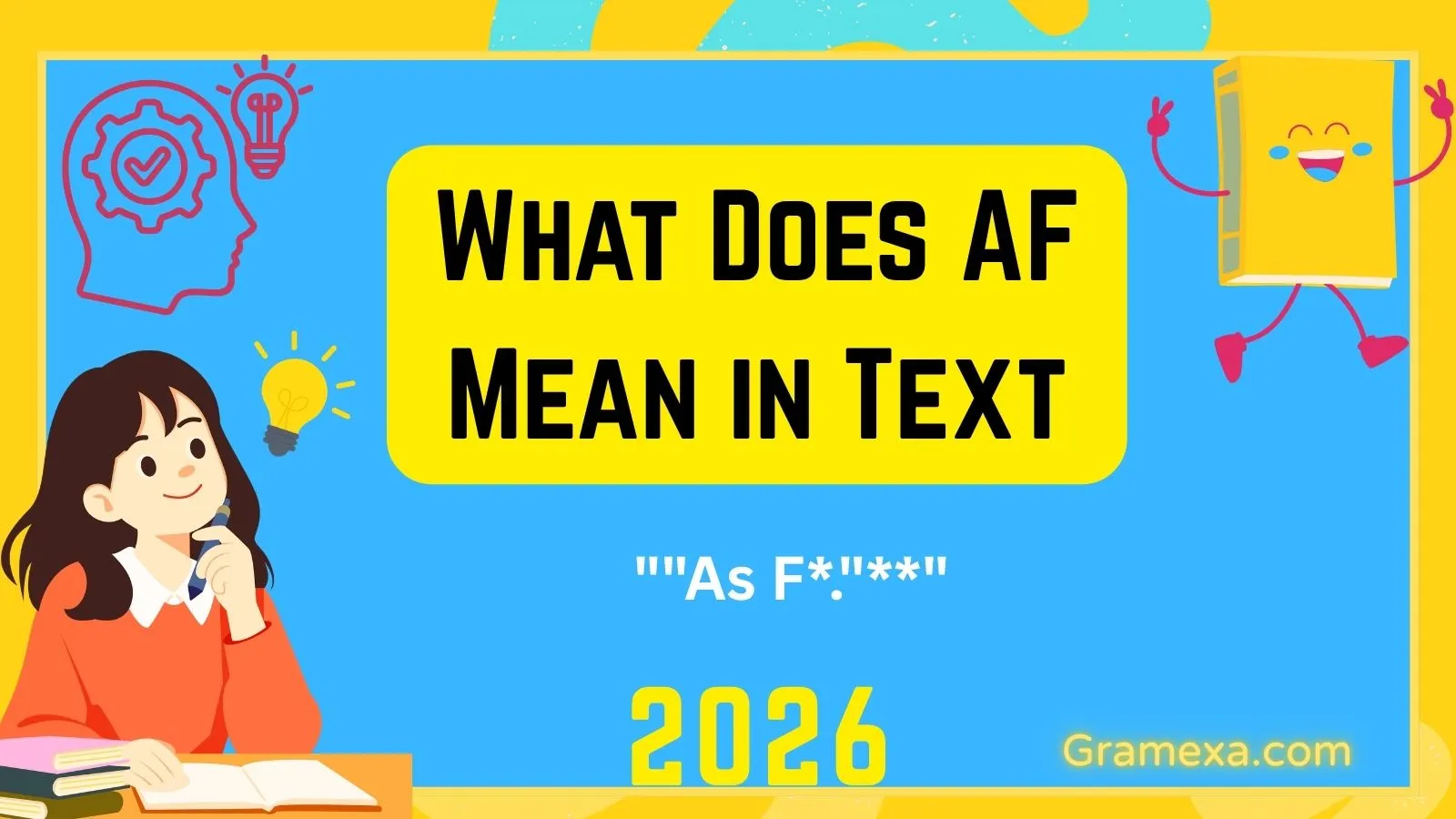
AF Stands For: “As F*.”**
Today, people use AF to add extra emotion to a sentence. It can show that something is very good, very bad, very funny, or very exciting.
In this guide, you will learn What Does AF Mean in Text, where it came from, how people use it, when you should avoid it, and better alternatives for formal situations.
By the end, you will understand this popular internet slang with confidence.
Let’s Dive In!
Definition & Meaning
AF stands for “As F*.”**
People use it to make an adjective stronger. It simply means “very” or “extremely.”
The full phrase contains a swear word, so many people only write the initials AF instead of spelling it out.
Simple Formula
Adjective + AF = Very or Extremely
Examples
- I’m tired AF.
- This pizza is good AF.
- That exam was hard AF.
- Your new phone is cool AF.
- The weather is hot AF.
In each sentence, AF makes the feeling stronger.
Text Conversation Example
Sara: How was the hike?
Ali: It was fun AF!
John: Is the game difficult?
Mark: Yes. It’s hard AF.
Why Do People Use AF?
People use it because it is:
- Short
- Easy to type
- Expressive
- Popular online
Instead of writing “very,” many younger users prefer AF because it sounds more emotional and casual.
Background & History
The phrase “as f*”** has existed in spoken English for many years. People often used it to emphasize strong feelings during conversations.
As texting and the internet became popular, users wanted a shorter way to write the phrase.
That is when AF became common.
Social media helped spread it even faster.
Platforms like:
- Twitter (X)
- Snapchat
- TikTok
made AF part of everyday internet language.
The short form became popular because many websites limit characters, and people wanted a cleaner version of the original phrase.
Today, millions of people use AF without even thinking about the original words behind it.
Although the abbreviation hides the swear word, most people still understand its meaning.
Usage in Various Contexts
1. Text Messages
Friends often use AF while chatting.
Example
Emma: Are you hungry?
Noah: Hungry AF!
2. Social Media
People use AF in captions and comments.
Examples:
- This sunset is beautiful AF.
- My dog is cute AF.
- Vacation mode AF.
3. Gaming
Gamers use AF to describe matches or players.
Example
Player 1: That boss is hard AF.
Player 2: I know!
4. Casual Conversations
Friends sometimes say it aloud.
Example:
“I’m excited AF for the concert.”
5. Memes
Many funny memes use AF because it adds extra emotion.
Example:
“Monday morning tired AF.”
Common Misconceptions & Clarifications
Many people misunderstand AF.
Here are the most common myths.
Myth 1: AF Is a Polite Word
No.
AF stands for a phrase that includes a swear word.
Although only the initials appear, many people still consider it informal.
Myth 2: AF Means Angry
Not usually.
AF does not describe one emotion.
It simply makes another word stronger.
Example:
- Happy AF
- Sad AF
- Busy AF
- Cold AF
Myth 3: AF Is Professional
No.
Avoid using AF in:
- Business emails
- Job applications
- School reports
- Formal presentations
Myth 4: Everyone Uses AF
Not everyone.
Older adults and professional workers may rarely use it.
Similar Terms & Alternatives
Many expressions have the same purpose.
| Term | Meaning | Professional? |
| AF | Very, extremely | No |
| Very | Strong emphasis | Yes |
| Extremely | Strong emphasis | Yes |
| Super | Informal emphasis | Usually |
| Really | Common emphasis | Yes |
| So | Adds emotion | Yes |
| Incredibly | Strong emphasis | Yes |
Examples
Instead of:
“I’m busy AF.”
You can say:
- I’m very busy.
- I’m extremely busy.
- I’m really busy.
- I’m incredibly busy.
How to Respond to AF
Your response depends on the situation.
Casual Response
Friend: I’m tired AF.
You: Go get some sleep!
Funny Response
Friend: This pizza is good AF.
You: Save me a slice!
Supportive Response
Friend: I’m stressed AF.
You: I’m here if you need help.
Professional Response
If someone uses AF in a work chat, avoid repeating it.
Instead say:
“I understand.”
or
“That sounds challenging.”
Privacy Conscious Response
If the topic is personal:
“I hope everything gets better.”
Regional or Cultural Differences
AF is mostly used in countries where English is common.
These include:
- United States
- Canada
- United Kingdom
- Australia
- New Zealand
Many people who speak English as a second language also use AF online.
However, some cultures avoid slang that comes from swear words.
In professional environments worldwide, AF is generally discouraged.
Some regions also have their own slang for emphasis.
Examples include:
- Super
- Mega
- Really
These alternatives are often safer in mixed audiences.
Comparison with Similar Terms
| Expression | Meaning | Tone | |
| AF | Extremely | Casual | |
| Very | Strong | Neutral | |
| Really | Strong | Friendly | |
| Super | Strong | Casual | |
| Totally | Complete agreement | Casual | |
| So | Strong emotion | Casual | |
| Extremely | Very strong | Professional |
Main Difference
AF is much more informal than the others because it represents a swear phrase.
Usage in Online Communities & Dating Apps
AF appears on many online platforms.
Tinder
Users may write:
- Cute AF
- Funny AF
- Sweet AF
It helps describe someone in a playful way.
Twitter (X)
Examples:
- Monday AF.
- Busy AF today.
Common captions include:
- Happy AF.
- Blessed AF.
- Relaxed AF.
Gaming Communities
Players often say:
- Laggy AF.
- Hard AF.
- Fast AF.
Tips
- Know your audience.
- Avoid using AF with strangers.
- Keep it casual.
- Skip it in professional networking.
Hidden or Offensive Meanings
AF usually has only one meaning.
However, because it represents a swear word, some people may find it offensive. Older readers or workplace managers may dislike seeing it.
Parents may also prefer children not to use it.
Tone matters.
Example:
“I’m excited AF.”
This sounds playful.
But writing it in a formal email may appear disrespectful. Always think about where you are posting.
Suitability for Professional Communication
AF is not recommended in professional settings.
Avoid it in:
- Business emails
- School assignments
- Office chats
- Customer service
- Interviews
- LinkedIn posts
Instead use words like:
- Very
- Extremely
- Highly
- Quite
- Really
Professional Example
Instead of:
“The project is difficult AF.”
Write:
“The project is extremely challenging.”
This sounds respectful and professional.
FAQs:
1. What does AF mean in text?
AF stands for “As F*.”** It means very or extremely.
2. Is AF a bad word?
The abbreviation itself is not a swear word, but it represents one. Some people may find it offensive.
3. Can I use AF at work?
No. It is best to avoid AF in professional communication.
4. Is AF popular on social media?
Yes. It is widely used on TikTok, Instagram, X (Twitter), Reddit, and Snapchat.
5. Can older people understand AF?
Some do, but many older users may not recognize internet slang.
Conclusion:
What Does AF Mean in Text is one of the most common slang abbreviations used online today. It stands for “As F*”** and simply means very or extremely.
You will often see it in text messages, memes, social media posts, gaming chats, and casual conversations.
While it adds emotion and emphasis, remember that it comes from a swear phrase. Because of this, it is not suitable for formal emails, school assignments, business communication, or professional settings.
Understanding the meaning of AF helps you read online conversations more easily and communicate with confidence.
When speaking with friends, AF can sound fun and expressive. However, when writing to teachers, employers, or clients, choose professional words like very, extremely, or highly instead.
Knowing when to use internet slang and when to avoid it is an important part of modern digital communication.
Read More Posts
- What Does IFK Mean in Text? Full Meaning Explained Simply
- What Does Bulk Mean in Text: With Meaning And Examples (2026)
- What Do ONB Mean in Text? Real Meaning & Examples (2026)

I am Grace Murphy a skilled grammar writer from United USA known for creating easy to understand language guides. Through Gramexa.com, I helps readers master grammar with simple and effective explanations.